


UAE Regulatory Updates 2026: Regulatory Shifts UAE Businesses Must Prepare For
With economic diversification in UAE and alignment of global standards, 2026 has brought significant regulatory reforms that businesses need to prepare for. Such changes span AML tightening, compliance enforcement trends and tax reforms that restructure how companies operate, report and demonstrate transparency in operational and financial activities.
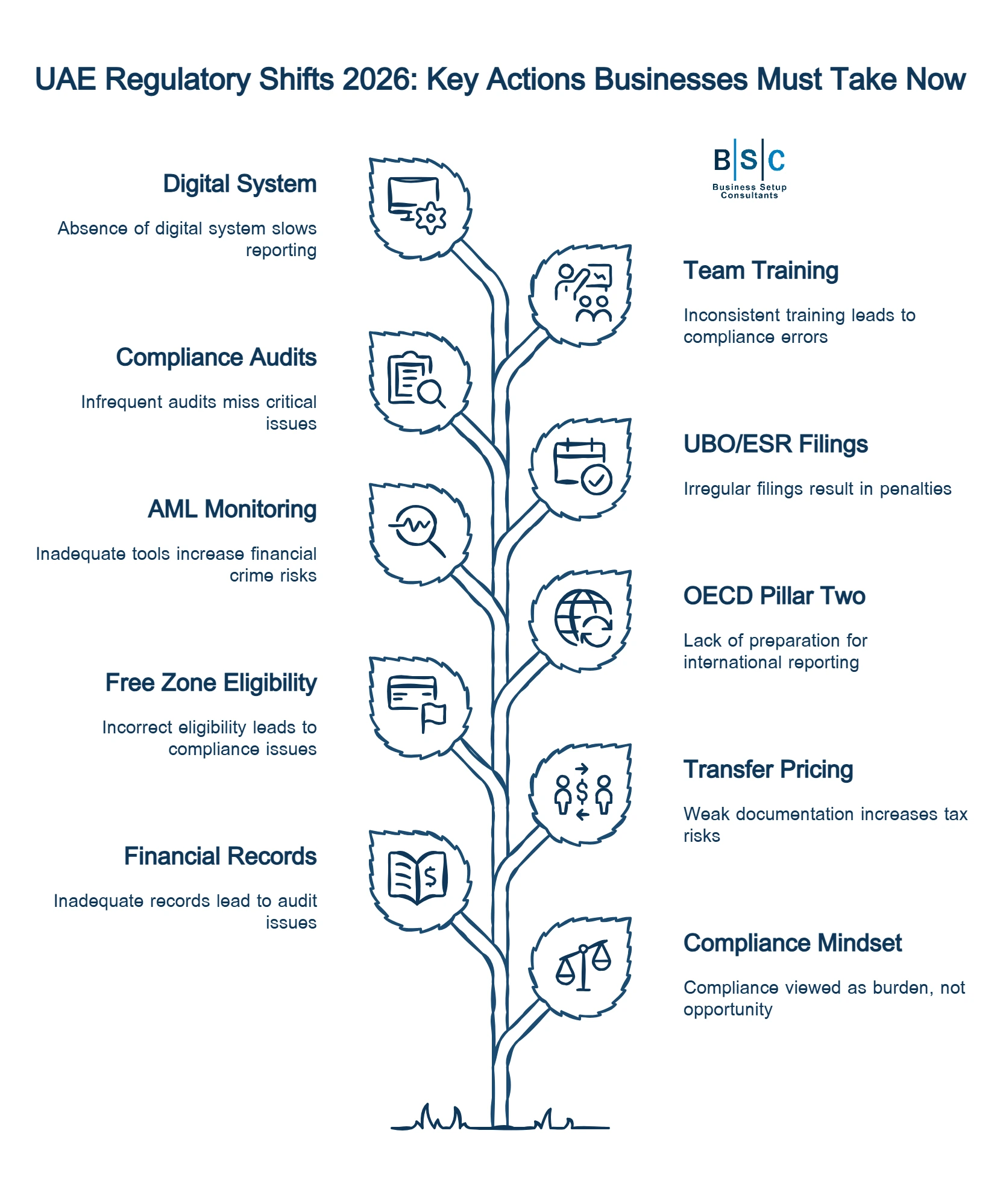
Tax changes: Transforming the UAE Tax framework
The Ministry of Finance in UAE has brought comprehensive tax procedural reforms along with VAT amendments effectively from first January 2026 under Federal Decree Laws No. 16 and 17 of 2025. This has been emphasized to carry modernisation of tax regime, compliance mechanism and enhancement of tax laws.
Key highlights:
Since the introduction of 9% corporate tax in 2023 under the Federal Tax Authority, there has been a consistency maintained for regulatory refinements. Here is what businesses should anticipate in 2026:
- Expected tax areas
- Strict Transfer pricing documentation.
- Increased audit frequency.
- Clarity on free zone qualifying income.
- Improved multinational groups reporting.
- Proper alignment with OECD global minimum tax rules.
- Compliance review
| Area | 2026 Focus | Risk level |
| Corporate Tax | Transfer pricing audits. | High |
| VAT | Real-time reconciliation checks. | Medium |
| Free zones | Qualifying income scrutiny. | High |
| Multinationals | Pillar two readiness. | High |
Action strategy:
- Conduct annual tax health checks.
- Maintaining contemporary transfer pricing documentation.
- Review of freezone substance requirements.
- Preparation for potential OECD driven reporting obligations.
UAE Business exit strategy 2026 is now a concerning topic among entrepreneurs – Do read to get updated!
AML tightening with wider scope and stronger enforcement
UAE has significantly strengthened AML frameworks for maintaining global credibility. In 2026, the Central Bank of UAE and the Ministry of Economy are expectedly intensifying supervisory actions.
- Key AML Shifts
- Improved UBO verification.
- AI based transaction monitoring.
- High penalties for non-compliance.
- Compulsory suspicious transaction reporting automation.
- Specific sector AML inspection for gold trading, fintech and real estate.
- High risk sectors in 2026
- Fintech and financial services.
- Precious metals traders.
- Corporate service providers.
- Real estate brokers.
- Mitigation measures
- Get the AML policies annually updated.
- Apply automated screening tools.
- Train compliance officers quarterly.
- Conduct risk-based customer due diligence.
Compliance enforcement trends
There will be a shift in trends from awareness-based compliance to strict enforcement lead governance.
- Expected enforcement patterns
- Random inspections.
- Digital compliance tracking.
- Penalty disclosure in public.
- Quick license suspension on violations.
- Cross authority data sharing.
Note: Authorities are integrating AML, tax and commercial license data systems. This minimises loopholes and increases detection speed.
Also look into UAE business risk assessment – Readers’ choice in 2026!
- Enforcement Risk Table
| Risk Area | 2026 trend | Mitigation method |
| Licence renewal | Strict document checking | Quick renewal audits |
| Banking compliance | Account freezes for AML gaps. | Consistent transaction review. |
| ESR and UBO | Cross verification through the data system. | Updated filings. |
| Tax filing | Automated red flag analytics. | Accurate bookkeeping. |
Technology driven regulatory oversight
The UAE is consistently investing in digital governance platforms in 2026.
Here is a quick list for you:
- AI-powered compliance dashboard.
- Expanding real time reporting portals.
- Digital audits to maintain standardisation.
- Expansion for e-invoicing frameworks.
Note: This indicates smart government strategy and international competitive ambitions of UAE in 2026.
Strategic business preparation framework
In order to remain resilient under the UAE regulatory updates 2026, businesses need to adopt a proactive compliance roadmap.
Governance
- Appoint a dedicated compliance leader.
- Conduct quarterly board level compliance review.
Financial planning
- Regulatory audit-based budget.
- Maintaining cash reserves for tax adjustment.
Regional scaling
- Structure entities effectively across free zones and the mainland.
- Align AML and tax frameworks across subsidiaries.
Documentation
- Maintaining updated UBO registration.
- Storing digital audits trails.
- Ensuring ESR filing.
Conclusion
UAE regulatory updates 2026 highlights stricter enforcement, clear tax oversight and tighter AML controls. Businesses that invest in proactive compliance, strategic governance and digital systems will definitely secure regulatory confidence and sustainable growth.
Let’s connect with us to ensure your business activities and structure completely align with new reforms in 2026.
Frequently Asked Questions (FAQs)
Will corporate tax rates increase in UAE in 2026?
It is not confirmed to increase beyond 9% in the United Arab Emirates, but OECD Pillar Two may impact multinational groups exceeding global revenue thresholds.
Are UAE freezone companies fully exempt from corporate tax?
No, only qualifying income under approved activities remains eligible for 0% tax in UAE freezones. Non-qualifying income is taxed at 9%.
How will AML enforcement evolve in UAE in 2026?
Expect automated monitoring, higher administrative penalties, and sector-focused inspections across regulated entities in the UAE.
Can businesses face license suspension in UAE for compliance gaps?
Yes, repeated AML failures, false UBO declarations, and tax non-compliance in the UAE can lead to penalties and license suspension.
What is the biggest compliance risk for SMEs in UAE in 2026?
Weak internal documentation and poor audit trails remain the biggest compliance risks for SMEs operating in the UAE.