

Sohar Freezone License Types: Strategic Selection Framework for Businesses
The purpose of this blog is to provide a clear strategic framework for choosing the right Sohar freezone license type. This helps investors to align their business model in terms of regulatory requirements.
Within Sohar freezone, license selection appears to be a foundational decision that implicates scalability, compliance and profitability in the long run. As Oman consistently positions Sohar as one logistics and industrial hub, businesses must ensure that their licensing structure needs to align with future expansion and current operational plans.
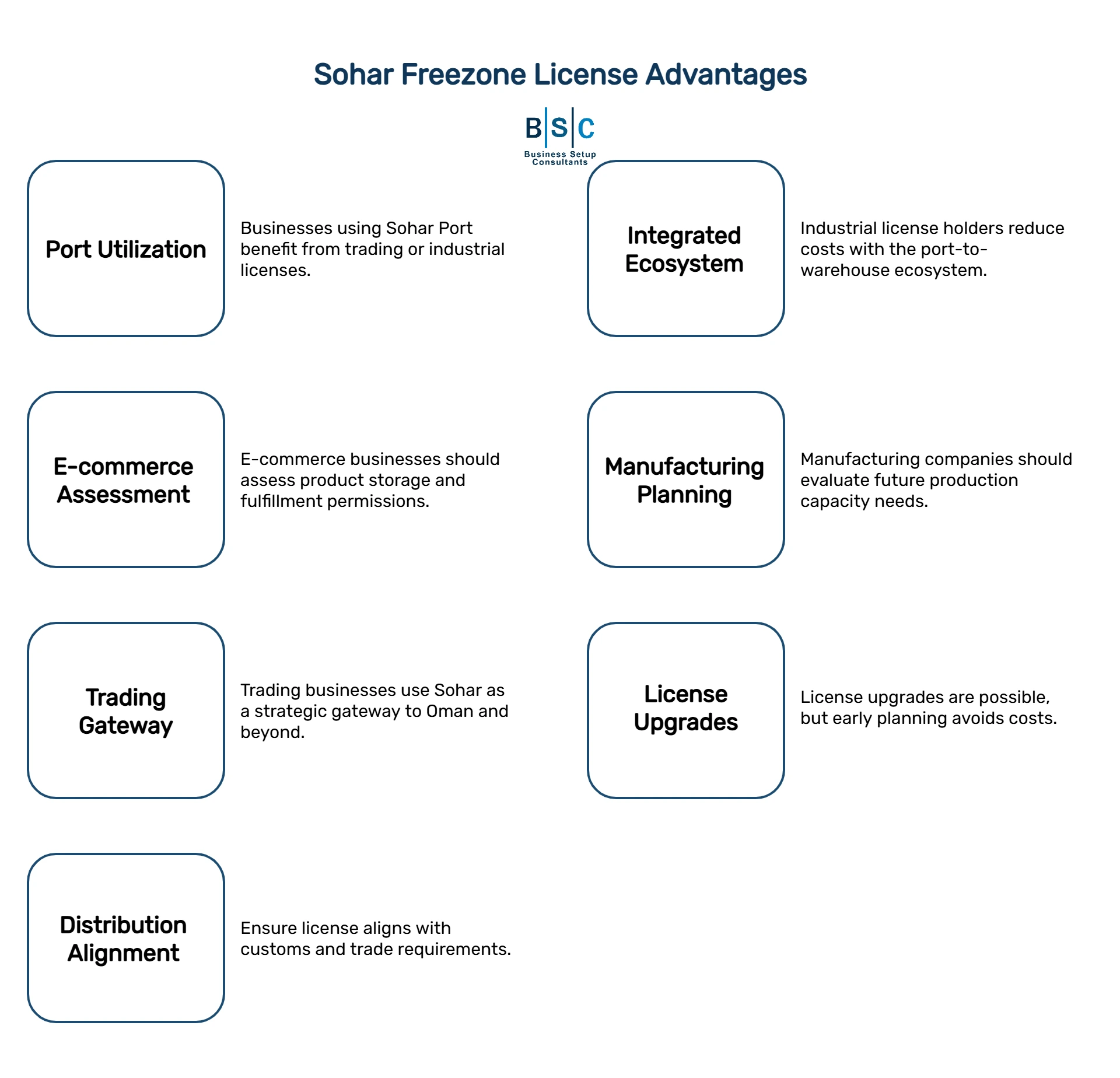
Core Sohar freezone license types
Understanding the available Sohar freezone license types is the initial step toward an informed decision.
- Trading License
- Favourable for import, export, distribution and general trading activities.
- Best for businesses dealing in physical goods.
- Accessible to regional and global markets.
- Service License
- Structured for non-physical, professional and consultancy offerings.
- Common for marketing, finance, IT and advisory firms.
- Minimise infrastructure requirements compared to industrial or trading licenses.
- E-commerce License
- Personalised for digital and online business models.
- E-Commerce licenses cover drop-shipping, online marketplace and platform-based sales.
- Demand increments due to digital transformation across GCC.
- Industrial License
- Required for processing, manufacturing and assembly operations.
- Include land allocation, infrastructure and higher compliance.
- Strongly guide Sohar port and logistic ecosystem.
Also, read about the UAE Golden Visa, it’s highly trending among expats!
Operational and regulatory considerations
Each of the license types cover specific regulatory and operational implications. Here is a quick breakdown:
- Facility requirements: Industrial licenses demand land or warehouses whereas service licenses may operate through flexi-desk.
- Approved complexity: Manufacturing activities involve environmental and technical approvals.
- Customs and trade compliance: Trading and industrial businesses must follow import or export regulations.
- Visa allocation: Linked to facility size and business activity.
- Capital and investment requirements: Major for industrial setup as well as service-based operations.
Aligning business model with license type
The right license is strongly responsible for your business and accelerates it. Hence, businesses must ensure:
- Operational nature: Physical goods vs services vs digital.
- Revenue model: Trading margins, service billing or production output.
- Target market: Local, GCC and global.
- Growth strategy: Scalability, expansion and diversification.
Example:
- A company planning to sell products digitally across GCC need to consider a hybrid structure (trading + e-commerce alignment)
- A consultancy firm does not require warehouse space as selecting unnecessary trading licenses would increase unwanted costs.
Before selecting a license category, investors should understand the broader company formation framework, regulatory environment, and setup requirements within Sohar Freezone.
Risks of misalignment and compliance issues
Selecting the wrong license type can lead to serious challenges.
- Operational restrictions: Activities outside license scope need to be prohibited.
- Penalties and fines: Regulatory authorities non-compliance.
- Increased cost: Required for restructuring or re-licensing.
- Delayed expansion: Difficult in scaling operations because of license limitations.
- Reality check: Most of the time first time investors choose licenses in terms of cost instead of strategy. This leads to long term inefficiencies.
Also, readers search for UAE corporate bank account in 2026!
Conceptual framework for license selection Simplification of decision-making, businesses can follow this strategic framework.
Define core activity
- What is your primary revenue driver?
Map operational requirements
- Do you demand manufacturing, storage or just office space?
Assess regulatory impact
- What approvals and compliance needs apply?
Scalability plan
- Will your business expand into new activities or markets?
Cost optimisation vs functionality
- Balance initial investment with long term operational flexibility.
Businesses should also consider future administrative obligations when selecting a license structure. Understanding the process of Sohar Freezone license renewal can help investors evaluate long-term compliance requirements and operational continuity.
Conclusion
Sohar freezone offers diverse licensing options designed for supporting global businesses, but the real benefits depend on strategic selection. Opting for the right Sohar freezone license type ensures operational freedom, cost-efficiency, regulatory compliance and growth potential in the long run.
Let’s connect with us to set your business for scalable business model development, expansion goals and activity decision making.
Frequently Asked Questions (FAQs)
What are the most common Sohar freezone license types?
Trading and service licenses are relevantly utilised for lower setup complexity.
Is it possible for one company to hold diverse activities under one license?
Yes, one company holds multiple activities under one license, but it should lie within the same license category.
Is an industrial license necessary for light manufacturing?
Yes, any production or processing work requires an industrial license.
Can I switch license types later?
Yes, you can switch but switching license types comprises approvals and additional cost.
Which license type is ideal for business startups?
Service or e-commerce licenses are typically the most cost-efficient for startups.