

VAT in the UAE 2026: What Free-Zone Businesses Must Know
Perhaps you know, VAT is one consumption tax which is applied on goods and services, with new VAT in the UAE 2026 there will be certain changes to be experienced in the UAE 2026.
Free zone businesses probably can suffer growing confusion due to VAT in the UAE 2026.
The question is – Do we pay VAT?
Are the designated zones still exempt? What deadlines matter? Missteps now can lead to penalties, cash-flow disruptions and rejected filings. Hope you need a clarity before the new rules come in, let’s explore this guide to understand this for Free Zone businesses.
VAT scope and applicability for VAT deadlines in the UAE 2026: What Free-Zone Businesses Must Know
You must know that not all the free zones are tax-free. Here is what you need to know about VAT in the UAE 2026.
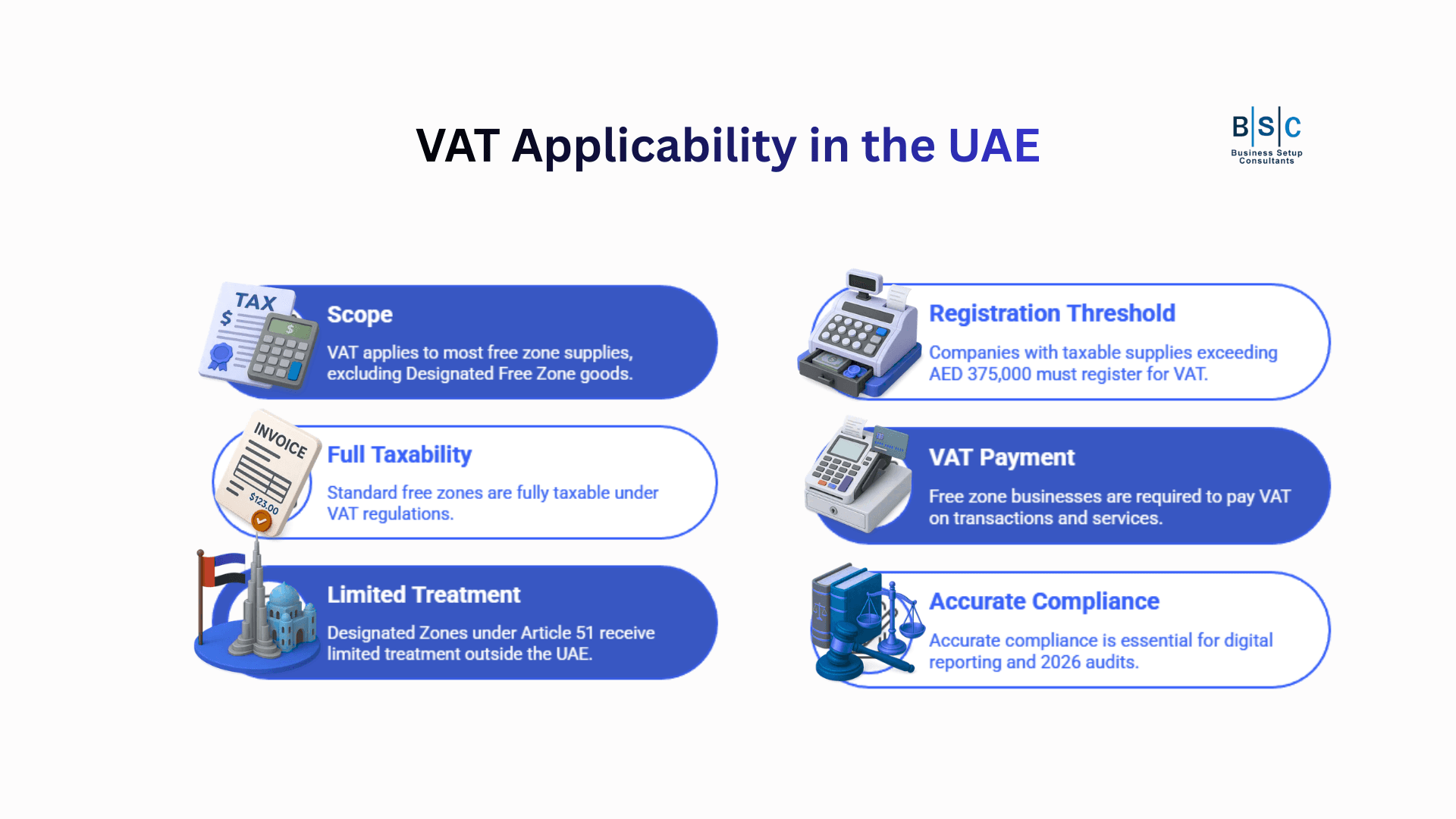
Scope: VAT is applicable to most of the free zone supplies except on the Designated Free Zone goods.
Applicability:
- Full taxability in the standard free zones.
- Under Article 51 Designated Zones get limited treatment outside the UAE.
- If taxable supplies exceed AED 375,000 then the company needs to register.
- Free zone businesses pay VAT on transactions and services.
- Accurate compliance is needed for digital reporting and 2026 audits.
Places of supply rules determining deadlines of VAT in the UAE 2026
To understand the places of supply rules for VAT in the UAE 2026, freezone businesses must know about wrong filings, penalty avoidance and missing of VAT deadlines in 2026.
Here is a quick breakdown depending on transaction types and place of supply rules best for understanding VAT deadlines.
| Transaction types | Explanation | VAT Treatment | VAT Deadlines |
| Local supply | Goods delivered → Supply in the UAE. | 5% VAT applied. | VAT return to be filed by 28th of the following tax period. |
| Imports | Goods entering UAE from foreign nations. | VAT paid through reverse charge. | Declaration of import VAT through return of filing deadline. |
| Exports | Goods shipped outside UAE; services for non-UAE customers. | Mostly zero-rated; evidence verification required. | Zero-rated sales prior to VAT deadline. |
| Designated zone transfers | Designated zones need to be treated as outside the state bodies. | Majorly zero-rated unless consumed in the UAE. | Comprises movement within the same VAT return period. |
| E-commerce deliveries | Online orders to be delivered in the UAE. | 5% VAT applicable. | Reporting of sales to be delivered at VAT deadline. |
Learn about existing VAT functions in detail.
VAT Compliance process: VAT in the UAE 2026 – What Free Zone Businesses Must know
Mastering VAT 2026 comes with proper compliance steps. As VAT in the UAE 2026 comes with stricter deadline matters that lead to delays and penalties.
Here is step by step procedure:
- Step 1: Get your TRN through VAT application – This is necessary because VAT registration is also applicable for non-resident businesses to make taxable supplies.
- Step 2: Record imports, exports, taxable supplies and exempt transactions.
- Step 3: Issue FTA approved invoices and utilised Tax credit Note UAE VAT Law while doing error correction.
- Step 4: For foreign services and exports must apply proper zero-rating rules.
- Step 5: File a VAT return prior to VAT deadlines utilising 2026 digital FTA portals.
- Step 6: Maintain audit-ready records and compliant book keeping.
Exemption and zero-related rules: VAT in the UAE 2026 (VAT deadlines)
It is important for the free zone businesses to master the exemptions for staying audit-proof in 2026. Here are the categories and VAT deadline implications that you need to know for your free zone businesses.
For More details contact with our VAT Consultant in Dubai;
| Category | Explanation | VAT deadlines implication |
| Zero rated supplies | Require strict documentation and timely compliance filing for export outside GCC. | Returns must be submitted before the VAT deadlines to attend zero-rated status. |
| VAT exemption | Some educational services and healthcare exempts and require accounting compliance for the audits. | Exempt firms require VAT deadlines for returns. |
| Designated Free zone | Goods within custom suspension are treated outside the state to enable zero-rated movement between designated zones. | There are risk delays in filings. Requirement to apply VAT deadlines. |
Key changes and its mitigation required to manage VAT deadlines 2026
It is necessary to manage and mitigate the challenges of VAT deadlines 2026. Learning these changes in 2026 can ensure better VAT in the UAE for your free zone business.
| 2026 change | Implication on the free zone businesses | Mitigation tips |
| FTA Scrutiny and tighter auditing | More checks on supply chain, invoices and free zone transactions. | Conduct VAT check and review transaction trail before VAT deadlines. |
| Mandatory digital reporting | Automated cross verification and data submission in real time. | Apply clean and error-free digital records and maintain accounting systems. |
| Developed place of supply enforcement | Misclassification can lead to backdated VAT and penalties. | Reassure place of supply rules for cross-border sales. |
| Reclassification of designated zones | Some of the zones might lose special focus. | Reassess the pricing and VAT exposure ahead of 2026 VAT deadlines. |
Conclusion
VAT deadlines are no longer hectic, As we learned here about digital reporting, tighter audits and stricter rules. This makes it more important for VAT in the UAE 2026.
Whether you perform with your business in the standard free zone or in any designated zone you now have learned the necessity of VAT, registration significance and exemptions.
Connect with Us for your smartest move into VAT processing rather than waiting for 2026.
FAQs
Q1. Are free zone companies required to register for VAT in the UAE 2026?
If the taxable supplies are worth AED 375,000 annually then VAT registration is necessary.
Q2. Is the designated free zone businesses exempt from VAT?
VAT is applied unless the transaction qualifies for outside the UAE status in designated zone rules.
Q3. What is the VAT deadline for filing returns?
Majorly, businesses file quarterly but some of the companies assigned by FTA do it under monthly deadlines.
Q4. Do exports from free zones qualify for the zero-rated VAT?
Yes when the goods are exported to the customers outside the UAE and with proof of export conditions.
Q5. Is there any requirement for VAT registration for non-resident companies in the UAE?
Only when the supply is regarding taxable goods and services then VAT registration is needed for non-resident companies in the freezone UAE.