
Virtual Asset License in the UAE: Understanding the Regulatory Framework for Digital Asset Businesses
The most progressive regulatory system for Virtual Asset License in the UAE creates attractiveness for Web3, blockchain and virtual asset businesses.
Getting a Virtual Asset License in the UAE is significant regarding businesses conducting regulated virtual asset activities.
Observing the applicable regulators, compliance obligations and licensing categories support companies to operate investor confidence in the long run.
In this guide, you will find detail about Virtual Asset License in the UAE comprising VASP categories, regulated and non-regulated activities, compliance expectations, and future regulations
What is a Virtual Asset License in the UAE?
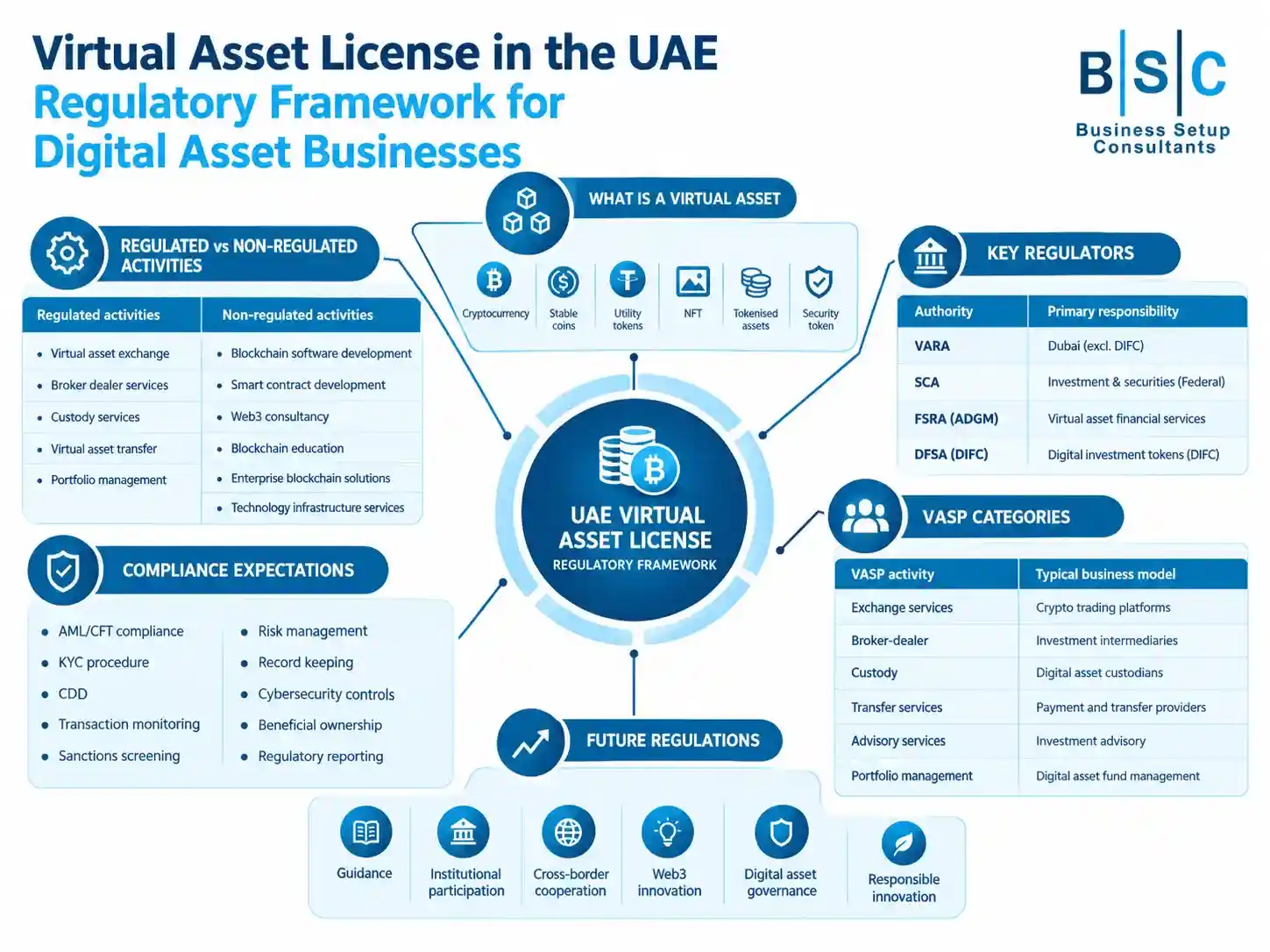
A Virtual Asset License in the UAE is one digital value representation that can be utilised for digital trade, transfer or investment and payment purposes.
The examples are:
- Cryptocurrency.
- Stable coins.
- Utility tokens.
- NFT.
- Tokenised assets.
- Security token.
Regulatory treatment of Virtual Asset License in the UAE rely on features and intended utility.
Regulated vs non-regulated activities
Similar regulated approvals are not applicable on every blockchain-based business.
| Regulated activities | Non-regulated activities |
| Virtual asset exchange | Blockchain software development |
| Broker dealer services | Smart contract development |
| Custody services | Web3 consultancy |
| Virtual asset transfer | Blockchain education |
| Virtual asset advisory | Enterprise blockchain solutions |
| Portfolio management | Technology infrastructure services. |
It is necessary for businesses to assess activities carefully due to diverse regulatory dependency on jurisdiction and business models.
VARA, SCA & ADGM roles
Diverse authorities are responsible for regulating virtual asset activities in terms of business model and jurisdictions.
| Authority | Primary responsibility |
| VARA | It regulates Dubai based eligible virtual asset activities excluding DIFC. |
| SCA | Look after investment activities, security and virtual asset matters in terms of UAE Federal regulations. |
| FSRA (ADGM) | Responsible for regulating virtual asset financial services in Abu Dhabi Global Market. |
| DFSA (DIFC) | Regulates recognised digital investment token activities in DIFC. |
It is necessary for businesses to determine jurisdictional authority prior to licence application.
VASP categories
A Virtual Asset Service Provider (VASP) requires authorisation depending on its activities. The common categories involve:
| VASP activity | Typical business model |
| Exchange Services | Crypto trading platforms. |
| Broker-dealer | Investment intermediaries. |
| Custody | Digital asset custodians. |
| Transfer services | Payment and transfer providers. |
| Advisory services | Investment advisory. |
| Portfolio management | Digital asset fund management. |
License availability relies on an applicable regulator.
Compliance expectations for Virtual Asset License in the UAE
Virtual asset businesses are expected for maintaining risk management and strong governance. Key compliance obligations involve:
- AML/CFT compliance.
- KYC procedure.
- Customer Due Diligence (CDD).
- Transaction monitoring.
- Sanctions screening.
- Risk management framework.
- Record keeping.
- Cybersecurity controls.
- Beneficial ownership disclosure.
- Regulatory reporting.
Compliance requirements differ in terms of regulator and license category.
Future regulations regarding Virtual Asset License in the UAE
UAE consistently strengthen its digital asset ecosystem by means of:
- Enhanced regulatory guidance.
- Institutional participation.
- Cross-border regulatory cooperation.
- Web3 innovation initiative.
- Digital asset governance.
- Responsible innovation frameworks.
It is necessary for businesses to monitor future regulatory development for ongoing compliance maintenance.
Conclusion
Obtaining a Virtual Asset License in the UAE require selection of proper regulator licensing obligation observance and maintenance of robust compliance standards.
Whether operating a crypto exchange, blockchain investment business or custody platform, regulatory alignment is always an important aspect of investor confidence and sustainable growth under the evolving digital asset ecosystem of the UAE.
Setup your digital asset business with BSC professionals to experience compliance solutions and tailored UAE licensing.
Frequently Asked Questions (FAQs)
Is it necessary for every crypto business to get a virtual asset license in the UAE?
Not every business but only those conducting regulated virtual asset activities require regulatory authorisation.
Which authority regulates virtual asset activities in Dubai outside DIFC?
Virtual Assets Regulatory Authority (VARA) is responsible for regulating virtual asset activities in Dubai.
Can a VASP license obtained in one UAE jurisdiction automatically be used across all Emirates?
No regulatory approvals for VASP license are only jurisdiction-specific unless otherwise permitted by relevant authority.
Are AML and KYC compliance necessary for licensed virtual asset businesses?
Yes, AML, CFT and KYC compliance are necessary regulatory obligations for licensed virtual asset businesses.
Is it possible for a blockchain software company to function without virtual asset license?
Yes, blockchain software companies can operate without virtual asset license only if they offer non-regulated technology services and conduct no virtual asset activities.