

Why Does Your UAE Bank Transaction Profile Matters to Banks?
A UAE bank transaction profile is consistently becoming a significant aspect of corporate banking in 2026.
It is because the UAE banks are regularly assessing whether actual account activity aligns with business information provided during the onboarding.
The expected payments, currencies, countries and transaction volumes support banks in understanding how the UAE bank account can be utilised.
Learn this guide regarding UAE bank transaction profile in order to get assistance with expected payments, business activity, transaction volumes and compliance necessities in 2026.
UAE Bank Transaction profile
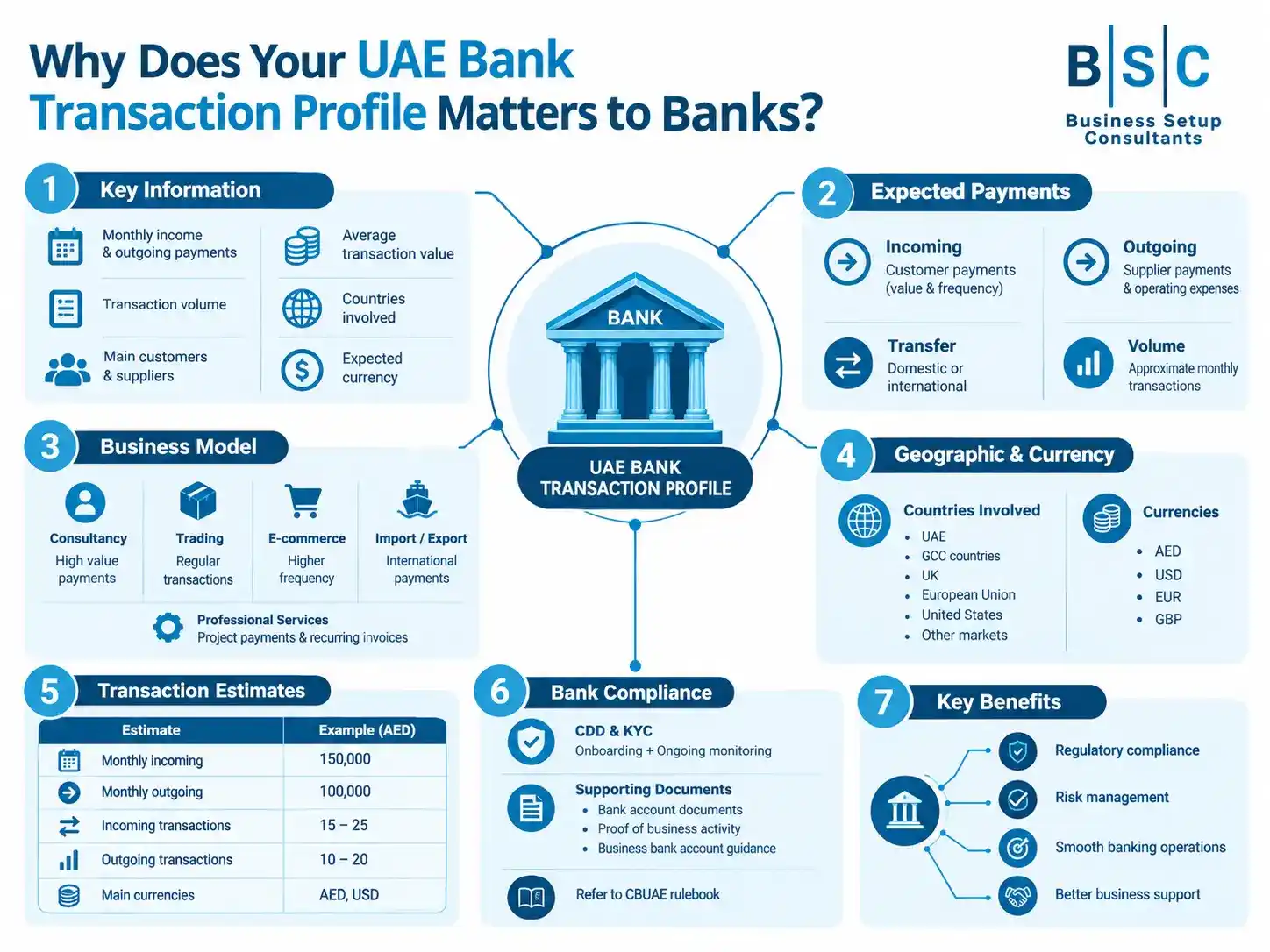
Your UAE bank transaction profile provides the bank with a practical picture of how money should move through your account.
- Expected monthly income payment
- Expected monthly outgoing payment
- Total number of transactions
- Main customers and suppliers
- Average transaction value
- Countries involved
- Expected currency
The CBUAE framework requires financial institutions to develop customer risk profiles by applying relevant customer information.
Such a profile directly connects with expected incoming and outgoing payments.
Expected incoming/outgoing payments
UAE banks expect information on both sides of the cashflow and not simply your expected revenue.
| Transaction type | Information to provide |
| Incoming | Customer payment, value and frequency. |
| Outgoing | Supplier payments and operating expenses. |
| Transfer | Domestic or international transfer. |
| Volume | Approximate monthly transaction. |
For instance, one trading company can expect frequent supplier payments, while a consultancy can have few but higher value client receipts.
The more common these estimates will be to your actual business model, the clearer your banking profiles will become.
Business model for UAE bank transaction profile
One realistic transaction estimate is required to tell the same story as your business activity.
- Consultancy: Few but high value client payments
- Trading: Regular customers and supply transactions.
- E-commerce: Higher transaction frequency.
- Import or export: International supplier and customer payment.
- Professional services: Project payments and recurring invoices.
UAE banks can consider customers, suppliers, business nature, expected transactions and revenue model in the time of reviewing business activity.
Countries involved in UAE bank transaction profile
Cross-border activities can develop geographic updates as an important part for UAE bank transaction profile.
It is important for the UAE Bank to acknowledge expected customers and suppliers. Certain involved countries are:
- United Arab Emirates
- GCC countries
- United Kingdom
- European Union
- United States
- Other relevant markets
CBUAE customer risk framework carry significant information whereas financial institutions develop risk profiles.
Currencies involved in UAE bank transaction profile
Details of the currency support in connecting international business models with actual account activity.
- AED for UAE operations
- USD for international customers
- EUR for European transactions
- GBP for UK payment
Only those currencies need to be declared that are generally related to expected business activity.
Transaction estimates for your UAE bank transaction profile
Accuracy is highly valuable than any inflated projection.
| Estimate | Example (AED) |
| Monthly incoming | 150,000 |
| Monthly outgoing | 100,000 |
| Incoming transactions | 15-25 |
| Outgoing transactions | 10-20 |
| Main currencies | AED, USD |
Necessary to support your estimates with invoices, purchase orders, business plans, contracts and previous transaction requirements if available.
Bank compliance regarding UAE bank transaction profile
It must be understood that the objective is not to bring an end to legitimate transactions however it is to identify activities that are not fit for the established customer profile.
Customer Due Diligence (CDD) and ongoing monitoring are delivered under UAE AML/CFT framework.
The CBUAE states ongoing monitoring checks whether account use remains consistent with customer profile developed through CDD/KYC.
In case of practical preparation to monitor suspicious behaviour of the customer activities under AML/CFT framework, reviewing is must for the following:
- Documents required for UAE corporate bank accounts.
- Proof of business activity in the UAE.
- UAE business bank account guidance.
In order to get complete knowledge of the regulatory framework refer to the official CBUAE rulebook.
Conclusion
The UAE bank transaction profile is required to perfectly reflect a business model, countries suppliers, customers currencies and expected payment volume.
Currently in 2026, UAE Banks are utilising CDD and KYC to assess account activity that are consistently establishing customer profiles.
Are you looking for professional support for UAE bank transaction profiles?
Connect with BSC for professional executive guidance.
Frequently Asked Questions (FAQs)
Why does UAE Bank need to keep expected monthly transactions?
UAE banks utilise expected activity for understanding normal account behaviour and help in ongoing transaction monitoring.
Is it possible to change expected transaction volume later?
Yes, it is possible to change expected transaction volume later but significant changes require updated information or supporting documents from the UAE bank.
What happens if the actual transaction exceeds my estimation?
The UAE Bank can ask for verification or evidence if the business activity appears inconsistent with UAE bank transaction profile.
Is it true that international transactions can impact UAE bank transaction profile?
Definitely, cross-border activity, counter parties and countries develop customer risk assessment of the UAE bank transaction profile.
Which documents are responsible for supporting expected transaction estimates?
Business plans, purchase orders, invoices, contracts and previous transaction records can support expected transaction estimates.