

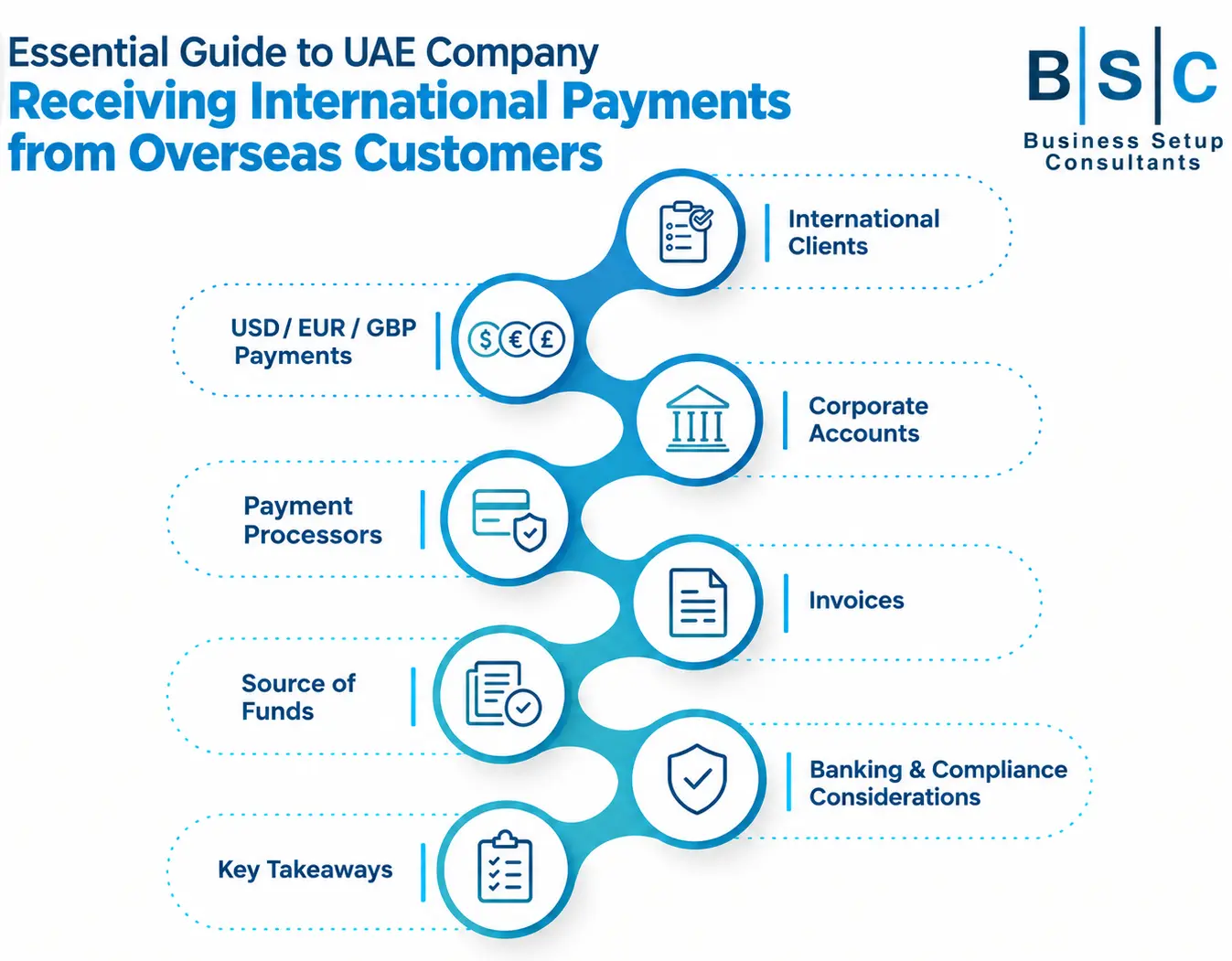
Essential Guide to UAE Company Receiving international Payments from Overseas Customers
A UAE company receiving international payments carries an arrangement that permits businesses to get money from overseas customers by means of ideal corporate banking channels.
In 2026 UAE businesses can perform with international clients and get payments in currencies like EUR, USD and GBP, subject to banking requirements compliance checks and payment service rules.
Learn how a UAE company receiving international payments comprises corporate accounts, invoices, payment processors, foreign currencies, source of funds and UAE compliance requirements.
UAE company receive international payments from international clients
International customers appear to be one major revenue source.
However, the payment flow needs to match with declared business activity.
- UAE companies require to invoice customers outside the UAE.
- Customers can pay through Bank transfers and approved payment platforms.
- Expected countries and customer types need to be clear to the bank.
- Contracts, service agreements and invoices can assist in the commercial relationship.
One UAE bank transaction profile can support establishing why overseas money is entering into a company’s account.
USD/EUR/GBP payments for UAE company receiving international payments
Collecting foreign currency can transform international trade easier if the banking structure supports it.
| Currency | Common utility |
| USD | US and global customers. |
| EUR | European customers |
| GBP | UK customers |
| AED | UAE operations |
The actual available currency relies on bank, account structure and transaction requirements.
Consideration for UAE company receiving international payments in corporate accounts
A corporate bank account is normally considered as a central point to receive overseas business revenue.
- It requires the account to be opened in the legal name of the company.
- It is important for the business activity to align with payment purposes expected.
- UAE banks may ask regarding customers, turnover, transaction frequency and country detail.
- Receiving capabilities of foreign currency differ in banks and account types.
UAE banks can also conduct CDD prior to initiation of banking operations.
It is necessary for account preparation to get the business review for the documents required to open a corporate bank account in the UAE.
Payment processors for UAE company receiving international payments
Payment processors are capable of simplifying international collections specifically in case of online businesses.
- Card payment
- Online check out
- Payment links
- Recurring payment
- Digital payment solutions
Payment processors can also conduct their own KYC and business verification.
Invoices for UAE company receiving international payments
A well-prepared invoice presents incoming payment with a clear commercial purpose.
An international invoice required to identify:
- Legal name of UAE company
- Customer name and address
- Invoice date and number
- Goods or service description
- Currency and amount
- Payment terms
- Approved payment instructions
It is necessary for the invoice to respond with actual transactions and the licensed activity of the company.
Source of funds for UAE company receiving international payments
It is necessary for banks to understand incoming monetary sources and why it is being received.
Useful supporting evidence comprises:
- Customer contracts
- Signed agreements
- Commercial invoices
- Purchase orders
- Delivery documents
- Bank payment record
Clear documentation can explain unusual or higher value transactions if the bank seeks additional information.
Banking and compliance considerations for UAE company receiving international payments
International payments are legitimate business activities but they are subjected to UAE banking and AML controls.
Under the UAE AML-CFT framework, banks carry transaction monitoring and customer risk assessment.
It can review whether the transactions appear to be consistent in terms of the business profile, source of funds and expected activity.
Businesses require to keep:
- Keep company and banking information updated.
- Maintain invoices and commercial contracts
- Assuring transaction activity aligning with licensed business models.
- Explanation of significant changes in payment volume.
- Responding promptly to bank compliance requests.
Official CBUAE Rulebook provides guidance on ongoing monitoring.
Conclusion
UAE company receive international payments arrangement is a support system that provides overseas customers with ideal payment and transfer operations through UAE corporate banks.
In 2026 businesses need to emphasize on source of fund transparency proper invoices customer information accuracy and banking requirement compliance.
Optimising proper receiving channels can cause international collections to be more organised and easy to manage.
Are you looking for professional support to receive customer payment by your UAE company?
Connect with BSC professionals to get guidance on documentation, corporate banking and payment setup.
Frequently Asked Questions (FAQs)
Is it possible for UAE companies to get payments from foreign customers?
Yes, UAE companies can generally get legitimate overseas business payments by means of ideal corporate banking or payment channels.
Can a UAE company receive payment in USD, EUR or GBP?
Definitely, UAE companies can get payments in USD, EUR and GBP in terms of its capabilities and payment provider consideration.
Does any UAE company receive international payments requiring a corporate bank account in the UAE?
In order to receive business revenue or payment, a legal company requires a UAE corporate bank account.
Can a payment processor be utilised rather than a bank transfer in UAE?
Definitely, UAE companies can utilise eligible payment processors that support business activities and compliance requirements.
What documents are required for receiving international payments in the UAE?
UAE Banks or payment processors can ask for contracts, invoices, purchase orders and other relevant documents that signifies source and fund purpose.